Snorkelling cenotes: which ones, what it is like and what you need
A cenote is not only for divers. Much of what makes one special sits in the first few metres, visible with a mask and snorkel.
Yes, you can snorkel a cenote
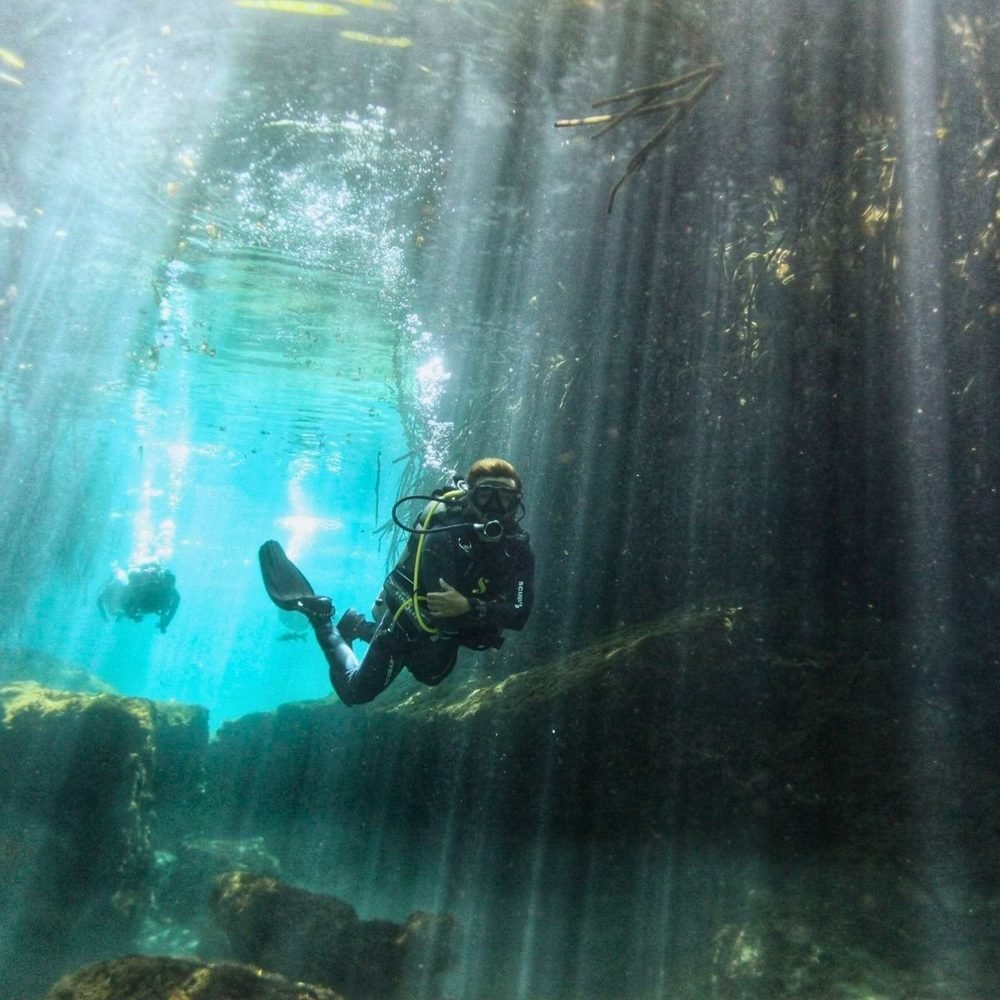
People assume cenotes are for divers. They are not. Much of what makes a cenote special — the clarity, the light beams, the rock formations — sits in the first few metres and is perfectly visible from the surface with a mask and snorkel.
In fact there is one thing you see better snorkelling than diving: the whole geometry of the cenote. From above you take in the entire chamber, beams coming in and stalactites hanging, instead of travelling through it.
What you will not see are the side galleries and closed chambers. Those need a tank. But if you are travelling with children, if someone in the group does not dive, or if you simply do not want to take a course, snorkelling a cenote is a complete activity in its own right — not a consolation prize.
What you see from the surface
The halocline, edge-on. At Casa Cenote the boundary between fresh and salt water sits four or five metres down. From the surface it reads as a rippling sheet, almost a second surface below you. It is strange, and it is free.
Complete light beams. Diving, you see the beam from inside; from above you see the whole of it, from the roof opening to where it lands. The snorkel area at Dos Ojos gives you exactly that.
The bottom, with unusual sharpness. With forty metres of visibility, a floor at eight metres looks like it is at one. Plenty of visitors think the water is shallower than it is until they try to free-dive down.
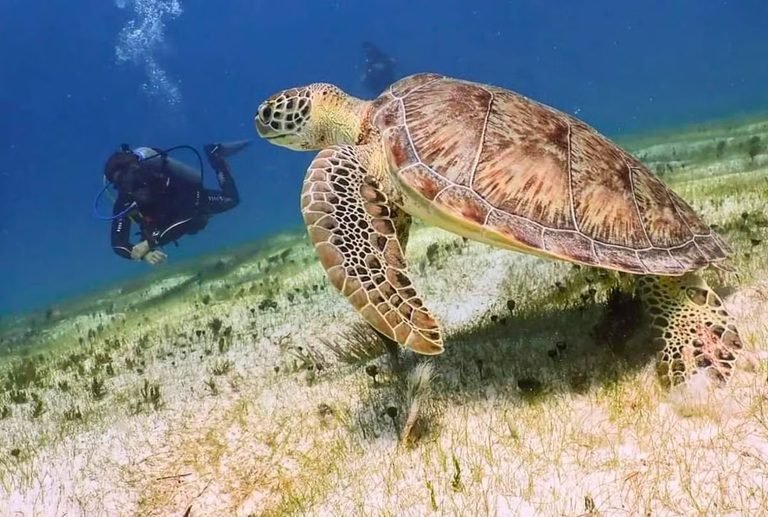
Small fish and freshwater turtles in the open cenotes such as Casa Cenote, where the mangrove brings life.
The cenotes that work best for snorkelling
Not all of them do. A vertical shaft cenote has nothing to offer from above. These three do:
Casa Cenote. The best by a wide margin. An open channel through mangroves, sky overhead throughout, three to eight metres of water and the halocline close to the surface. You can float the whole length of it. It is also the safest with children.
Dos Ojos. Has a designated snorkel area in the open part of the first «eye». You get the light beams and the cavern entrance, though you do not go inside.
Cenote Cristalino and the open cenotes around Tulum. Pool-type cenotes with a platform jump, very shallow at the edge and well lit. Less spectacular than Casa Cenote but very comfortable for a first taste.
What you need, and what you will be given
Buoyancy vest. Compulsory at most cenotes, even for strong swimmers. Not bureaucracy: fresh water holds you up less than the sea, and people notice.
Wetsuit. At a steady 25 °C, an hour floating without moving chills you more than you would expect. A shorty is enough.
Mask, snorkel and fins. Fins are optional at Casa Cenote, where you move very slowly, but they help.
No sunscreen. The most important rule and the most broken. A cenote is a closed system that does not flush: the oil film stays. If you have already applied it, there are showers at the entrance and you use them. Same for oil-based repellent.
And nothing gets touched. Not stalactites, not the bottom, not the wildlife. Many formations take thousands of years to grow a centimetre.
Snorkel or dive: how to decide
Snorkel if: you have children with you, someone in the group does not dive, you have half a day rather than a full one, you want to spend less, or the idea of a ceiling unsettles you.
Dive if: you want to enter the chambers, see the decorated galleries, cross the halocline from inside, or you have already snorkelled a cenote and wanted more.
And a third option most people do not consider: the Discover Scuba Diving at Casa Cenote. A real dive with an instructor, no course and no certification, in the same cenote where the snorkelling happens. If you are torn between the two, it is literally the answer in between. We cover it in the guide to diving without certification.
With children: from what age, and what to expect
Cenote snorkelling works well with children from around six or seven, as long as they can swim and are comfortable with their face in the water. Casa Cenote is the place: no ceiling, shallow at the edges, and life visible from the first minute.
What genuinely helps: vest on at all times, enter from the shallow end, and do not turn it into a long crossing. Half an hour used well beats two forced hours.
What does not work: taking a child into an enclosed cavern cenote and expecting them to enjoy it. The ceiling unsettles plenty of adults; a child more so.
Mistakes that spoil a cenote snorkel
Going to Dos Ojos at midday in high season. Best light, most people. If quiet is the goal, go first thing.
Skipping the wetsuit «because it is only snorkelling». Floating still chills you far more than swimming.
Applying sunscreen at the hotel. Even if you shower at the cenote, much has absorbed and will leach anyway. Better to apply none and wear a rash vest.
Expecting reef fish. A cenote is not a reef. If colour and marine life are what you want, the MUSA or the Puerto Morelos reef are the better plan. You visit a cenote for the light, the water and the rock.
And if what you want is snorkelling with a real school of fish, that is not in the Caribbean: it is in Cabo Pulmo, in the Sea of Cortez, where the walls of jacks start a few metres below the surface.
If you end up wanting to dive rather than just snorkel, our cenote diving page has the trips with and without certification.